
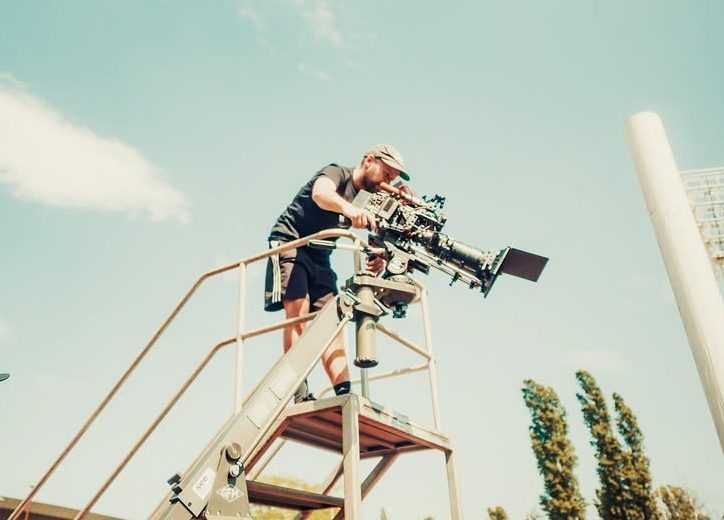
Manuel Schamberger is a Berlin-based DP who shoots feature films and fictional shorts like “Forever Yours” (Winner Best Cinematography at São Paulo Film Festival), music videos for artists like Fuffifuffzich or Milky Chance, and documentaries for both television and cinema. His latest feature film, sci-fi drama “Evolution of Machine – Epilogue” is currently in post production. Manuel also has extensive technical knowledge which explains his involvement with Altglas, now merged with RGB Rental. RGB has an extensive vintage and modern cinema lens collection and organizes workshops and lens nights regularly in Berlin.

Manuel is one of a kind. Every body who knows him will undoubtedly agree. He will make you feel like you have known each other for years the second you say hello. He’s the opposite of a gate keeper – he’s a door opener. Manuel opened the door to the film industry network in Berlin for me in 2022, after I moved back from London. We met at Camerimage in 2017, stayed in contact and in 2021, he came to London to crash at mine to drop off a Leica lens at TLS. I was mainly 1st ACing back then so when I finally moved to Berlin, I checked in with him to bring me on set to meet some people.
If it wasn’t for Manuel, I would have had a much, much harder time getting set up in Berlin and he and many people I’ve met through him are now dear friends of mine. Manuel seems to have endless supply of energy when it comes to things that he enjoys and shooting is definitely high up on the list. His energy is contagious. I’ve never been on set with him and thought this guy doesn’t belong here.
The following is an edit of an interview with him in June 2026.
You are quite a good skateboarder, you often have a skateboard with you on set that you modified for smooth, dolly-like shots. How did that influence you as a DP?
“I skate since I was 13 years old. The first time I borrowed my dad’s VHS-C camera, I used it to study my ollies, my kick-flips, my shove-its. I watched them frame by frame, just like I watched the tricks of the pro skaters on the VHS tapes I bought in the skate shop – there was no YouTube or other tutorial videos back then.
At some point, I found out that the perspective, the movement of the camera and the way I used the zoom made a huge difference. Sometimes it would help to make a trick or a [skate] spot bigger than it actually was, sometimes it could make the audience feel the actual size of the spot or the difficulty of the recorded trick. I still think that this is part of my job as a cinematographer today: to find images that make life look as big as it can feel sometimes. Or sometimes even bigger.”
Is skateboarding then how you actually got into filmmaking?
“Even before skateboarding, when I was a kid, I would put on a CD with a movie score and play with my planes, ships, cars, dinosaurs – with my eyes being the camera. I remember there were certain angles from which a plane would fly by my eyes in order to make it feel epic together with the music. I even build little cities, and if part of a building wouldn’t be seen from the “main perspective“, I would only build parts of it – like in a movie set. Then later, while creating skate videos, it was always also about picking the right music and editing the footage so it flows with it. So maybe my first kind of encounter with the music video world could actually have been the skate videos I’ve edited.
Do you remember the first music videos you saw?
My parents didn’t have cable or satellite TV at first, so I could only watch
MTV, Viva and VH1 at my grandparents. I remember that as a 9 or 10 year old kid, I loved watching music videos so much that I would sometimes prefer it to playing outside with the others. I was allowed to watch TV for an hour at that time and I mostly chose to watch music videos only.
A little later, we had music television at home and my sister had her own little TV-VHS combo. So when she went out with her friends at night she let me watch TV and record on VHS. I remember having a tape where I recorded a lot of music videos on. I was very much into rap music, specifically Eminem at the time (we’re talking about 1999/2000), so it was a lot of that – but also other videos I thought looked and sounded cool. I basically started a little collection. I’m not 100% sure but the first videos I saw on MTV might have been videos like Wu-Tangs „Gravel Pit“ or videos from the Red Hot Chili Peppers.

I would pay good money for that VHS compilation. Tell me about the first music video that you shot?
It was for a rap artist from my hometown in South Germany, the song was about how life is super hectic and everyone expects you to make money to succeed and be respected – the hook was about how he doesn’t want to be part of that system, so we had a cute idea: we put him on a lounge chair in the middle of a pedestrian shopping street. In the edit I then sped up the other people, with him sitting in the middle. It feels very much on the nose, but being 16 years old, I remember being extremely proud of our idea. I think on that project I learned that I just love to find images and that it doesn’t have to be connected to skateboarding only. But it all really started a bit later when I moved to Berlin.
You went to Filmuniversität Babelsberg in Berlin. Going to university to study film and if it’s “worth” it is a relentlessly discussed question. What experiences stuck with you during your studies?
”University really gave me the chance to learn about people. They were all so very different! Every person there saw the world though a different lens – and that of course could be seen in their films. I couldn’t pick a single thing that especially formed me, but I would say aside from the whole technical aspect (we had some great classes and some shitty ones, like in any school) I learned to take myself back a little bit. I moved from completely DIY skate videos to projects where you work together with 10, 20, sometimes even more people. Everyone has their vision, everyone has something to give to a project. How do we manage to put all those visions and ideas together and have something we can all be happy about in the end?
Also I have to give credit to my classmates Greta Conte, Adam Graf, Janis Brod and Stephan Vogt. We learned so much from each other just by hanging out and of course helping each other on numerous projects during that time.
This sentiment, learning from other people and valuing each other’s perspectives and experiences, is carrying through your work I think, because the experience on set seems to be just as important as work itself.
“I don’t always feel like a cinematographer, I’m not Vittorio Storaro. Most of the time I feel like I’m more of a crafts person, and every craft is creative in one way or the other. But there are brief moments when I’m shooting something and I think to myself „now that’s cinematography“. Where an emotion is translated into an image, and my cinematography is part of making that happen. There are so many films with amazing cinematography, moments you watch and just think: „Oh my god, I could never have come up with an idea like that“.
What’s your favorite music video that you have shot?
“That’s an easy one, it’s Ego by Alex Rapp – not only because you assisted me on it. It might be one of the least watched music videos I have done, but it was a huge road trip with the loveliest people ever. It had two very important things that don’t come together very often: great locations and a whole lot of time.”
If you work in the film industry, I think most of us have had one experience that stressed them out more than any other: The shoot your mind drifts off to when you have trouble falling asleep anyway, just to relive it in minuscule detail. Would you share yours?
It was in my second year of film school, when our camera got stolen on the first day, before the shoot even started. They took it from the truck in the morning, we just put it aside and weren’t looking at it for a moment and then it was gone. I felt so horrible. We then started to shoot on my own little camera and photo lenses, but I felt so guilty, so messed up. I think I couldn’t really sleep for two days because I was so worried, I thought that no one would want to work with me again after this and when I found out that the university’s insurance wouldn’t pay for any of it, I knew that I was completely screwed, probably going into private bankruptcy.
Things took an unexpected turn, because after some really exhausting 5 days of shooting I got an anonymous call. On the day the camera was stolen, we put up flyers with my phone number on it, promising a 1000 Euro finder’s fee. So these guys called me and said that they „found“ my camera, but they weren’t happy with the 1000 Euros – they wanted more and in case we couldn’t pay it, they’d keep the camera. We’re talking about a fully rigged up Sony F55 with a 32mm Cooke S4 lens on, probably worth 80k back then.
When we got the call, I told my friend to record the conversation with his phone. At the moment they said they’d keep the camera, I knew we had a proper case of blackmail. So, we went to the police, set up a meeting point at a late-night store close by, with plainclothes police officers checking out the situation around us. I walked over to the shop with our sound engineer, where the guys were already standing around, sipping coffee and looking totally relaxed. They had no idea what was about to happen. When I saw that they had our camera with them, I gave the police the agreed-upon signal, and within seconds they were arrested. Absolute movie type of shit. And well… we got our camera back, the spell was finally over. After this absolute horrible experience with a very fortunate happy end, every other shoot from then on seemed pretty chill to me. It made me understand that even if a shoot is not going well, when behind schedule for example, that it could still be a lot lot worse than that. I think it taught me to stay relatively calm in very chaotic situations.

What film stood out for you recently?
“The coolest film I’ve seen in a while is “Un Poeta“ by Simón Mesa Soto. It’s a wonderful little comedic-drama that really has everything I love about cinema. The film is both profound and lighthearted – you don’t see that very often. It’s beautifully shot on 16mm by DP Juan Sarmiento G., who I got to talk to about this film. That was one of the most inspiring encounters I had lately, it really made me want to shoot my next fiction film so badly.”
And finally, what are your favorite music videos that come to mind?
Hard question, there are so many! I am thinking of “DJ Mehdi – Signatune“ (the first Romain Gavras video I saw, the style really blew my mind back then), “Tove Lo – He’s Gone“ (very creative and funny) and “Paolo Nutini – Iron Sky“ (just really killer images shot by legend Robbie Ryan at the wildest locations you can imagine). Lately the Yung Lean video for Storm video really impressed me, also directed by Romain Gavras, probably what most people would say right now? Hmm!
Check out Manuel Schamberger’s work on
manuelschamberger.com
or Instagram
Leave a Reply